Thoughts · 10 October 2013
Skill based education: learning from the past, embracing the future
Skill based Education: Learning from the past, embracing the Future
Skill based education is the future of education. But, before we talk about the future, I need to tell you a short story. It’s a story that sets the stage. If we look at the kind of learning we do today, its rather easy to figure out the genesis of the present day schooling. Its origin is from about 300 years ago from one of the biggest empires in history, the Victorian Empire. Imagine trying to run an empire of that magnitude without the aid of computers or mobiles. The Victorians actually succeeded at their system of governance with just pieces of paper traveling by ship, which was truly amazing! They created a global computer made up of people, which is still with us today. It is called the bureaucratic administrative machinery. In order to have that machine running, they needed lots and lots of people. So, they made another machine to produce those people, “The School”. The schools would produce people who would become part of the administrative machinery. It was required that these people were identical to each other in order to fit in the system like spare parts fit in a machine. It was established that they must know three things; they should have good handwriting, as the data would be hand written. They should be able to read and should be able to do basic mathematics in their head. They must be so identical that if a person moved from one place on the globe to another he could be instantly functional. The system that the Victorians created was so robust that it’s still there with us today, still producing identical people for an empire that no longer exists.
So the big question today is that is there a point in mass-producing spare parts for a non-existent system, and with no demand for such pupils, should we completely shut down the schools that produce these identical people? The wise thing to do would be to modify the schools and produce a more useful youth. Creativity is the process of having original ideas that have value. It is the deficiency of this creativity in children that creates identical spare-part like individuals.
Picasso once said, “All children are born artists, the problem is to remain an artist as we grow up”.
At schools we don’t grow into creativity we grow out of it! This certainly doesn’t mean that there is no need for schools. It means that schools should play a pivotal role in providing the more useful form of education. Yes, I am now talking about imparting a skill-based education without sucking creativity out of its students. After all, it’s the acquired skills that students use in their real lives. 9 out of 10 university pass outs claim that they use less that 10% of the information learnt at the university. Though, they also agree that they use almost all the skills learnt at schools and at universities. There seems to be even less need of learning the facts and information. In this age of technology where any sort of information is just a click away, the utmost need is to learn the skills that inculcate understanding and working knowledge rather than learning facts. I am sure most of us have watched science fictions - robots replacing humans is a very common topic. Without even us realizing, these movies are emphasizing the hard reality; society today doesn’t require human computers but individuals with understanding, creativity and skills.
If you think about it, children starting their education next year will be expected to retire in the 2070s. Therefore, we as educators are supposed to educate them for the future. However the truth is, no one can predict what the world will be like in the next 5 years. Yet we have this humongous responsibility to educate children to face the world for the next 60 years worth of working. Can we, as the teaching fraternity, say for certain that what we’re teaching will be useful decades later? One of the biggest problems with the teaching generation of today is that in order to keep pace with the growing technology, we first need to unlearn, in order to be able to learn something new. This wouldn’t have been a problem if we had learnt skills rather than facts during our own school lives. I feel that skills are eternal and integral to the human race whereas the facts and crammed up knowledge have a very short lifespan. Skills such as problem solving skills, analytical skills, teamwork, leadership, communication skills and research skills are some of the skills that are useful in real life. Though these skills are applied in schools and universities, they are unfortunately not taught there, even though some students happen to pick them up.
Once the students have successfully mastered the skill of self-learning, the major role of a teacher becomes limited to that of a motivator. A student under the right kind of motivation has the capability to find out the right type of resources and learn what is required of them. As far as knowledge is concerned, there is a large pool of resources available on the internet and elsewhere. People believe that online resources are more effective in learning. Imagine if you could pause and repeat your teacher a hundred times without wasting anyone else’s time and without annoying her a bit, this is the power of internet based resources. This gives the children their own space to understand the topics. The other advantage of online resource based learning is that the pseudo-impression of a fast and slow learner can be eradicated. Sometimes students take very long on the initial foundation topics where as once they are clear with that particular topic, they are able to race ahead with the other associated topics. Traditional, existing classroom teaching is based on equal distribution of time for each topic which may be right as far as planning a lesson goes but is not the most effective way of teaching. For example my son during his schooling generally spent hours on the initial basic topics. Most of his teachers thought him to be a slow learner but as a mother I noticed that once he has laid a strong foundation he is able to race ahead of his peers. Judging him exclusively by his initial studying hours he could be misconstrued as being a slow learner, though his marks and his level of understanding says otherwise. This can be attributed to his way of learning; where he emphasizes on the basic skills and understanding first. Thus the emphasis of a teacher should be on teaching skills and enabling actual understanding rather than just forcing them to cram facts.
We have already talked about the need and utility of skill-based education. I am sure this entire concept sounds like a very theoretical and philosophical one. So the obvious question is that how do we teach our students skills that last a lifetime and impart the learning culture? Confucious once said
“I hear and I forget
I see and I remember
I do and I understand.”
This I would say is the foundation of a skill based approach to learning. According to the oxford dictionary, skill can be defined as the ability to do something well. According to another source, “the proficiency, facility, or dexterity that is acquired or developed through training or experience” is called skill. Based on these two definitions it is clear that skill is not something that can be taught, it is learnt by practical training and the experience that you gain while doing it.
India has gone through a weird transformation as far as the education system is concerned. We started off with having the best education system in the world and with some of the oldest literary work, we are also credited to have the oldest educational curriculum in the form of the Vedas. Having the oldest and biggest universities and finally ending up being entrapped into the education system that trained slaves- the Victorian system - and sadly, to this day we are bound in the same vicious circle.
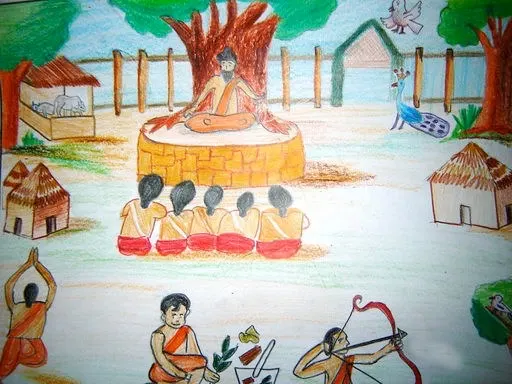
Lets evaluate why I talk so highly of the ancient Indian education systems. India had one of the earliest scripts written by mankind according to Brockington (1998). Ved Vyasa and Ved Valmiki authored the Mahabharata and the Ramayana respectively; which probably fall back to the 8th and 9th centuries BCE. The importance of these epics lies in the fact that their text is so practical in nature that even now one can relate to their teachings. Then came the oldest curriculum for education in the form of the Vedas. According to Gupta, Amita the Vedas included grammar and derivation, composition, understanding the secrets of nature (physics), reasoning including logic, the sciences and the skills necessary for an occupation. Some medical knowledge was included in the curriculum; the medication for various conditions or diseases such as fever, cough, baldness, snakebites was also part of the prescribed curriculum. It can be noticed that this curriculum emphasized skill based education, with special emphasis of the correlation between education and day-to-day needs. In the Vedic period existed the gurukul system of education; which was so effective that it produced some of the greatest minds in the past. Gurukuls were basically hubs for skill based education, these centers of learning imparted knowledge of religion, scriptures, philosophy, literature, warfare, statecraft, medicine, astrology and history. The varied topics that were taught at the Gurukuls were all practical application based and therefore could be called part of a skill-based education. It was these s
kills that were responsible for the scientific advancement in the past, as the acquisition of these skills required practical application and as per Confucious’s quote, invoked understanding amongst its pupil setting a firm foundation for advanced ideas to flourish. Bhaskaracharya, Kanada, Susruta, Charaka and Aryabhatta are some of the products of the vedic and gurukul systems. I am sure their contribution to their respective field is not something I need to talk about.
Following the age of the gurukuls, India was home to some of the biggest and earliest universities around the 5th century AD, when most of the world outside India struggled with even basic education. The centers for higher education like Nalanda, Takshashila, Ujjain and Vikramshilla Universities were so huge and famous that scholars from around the globe travelled vast distances to make the most of the huge range of topics that these universities provided. Art, architecture, painting, logic, mathematics, grammar, philosophy, astronomy, literature, buddhism, hinduism, arthashastra (economics & politics), law, and medicine. These all sound like modern day subjects, but the fact remains that these were fields of study that these universities provided. According to Suresh Kant Sharma, what is more surprising is that each university specialized in a particular field of study. Takshila specialized in the study of medicine, while Ujjain laid emphasis on astronomy. Nalanda, being the biggest centre, handled all branches of knowledge, and housed up to 10,000 students at its peak. The secret to all of these advancements is evident. It is nothing but the vedic scripts and the gurukul system which were both founded around the ideals of skill based education.
Despite the Indian systems being so good we still fell prey to the British in the 1600s. The reason was that first of all the Indian system of education had already been diluted due to constant invasions, as we were never a nation that encouraged war or conquest. Secondly, we failed to treasure the most important system of skill-based education. Today even the United States of America has begun to realized it - in 2010 President Barack Obama made the acquisition of skills to their youth a major focus, and from that came the Skills for America’s Future initiative, which brought together employers and community colleges to design a curriculum around skill based education. This initiative is based on providing skill-based education to university and college students.
The past is long gone, India is no longer that nation that had once introduced skill based education to the world, neither is it the nation that got colonized by the British, which eventually threw us a few centuries behind in terms of development. Today we are again emerging as a global power, but in order to maintain the pace that we have achieved in the past few decades we need to embrace the good from the past and learn from our mistakes. The youth of India demands that they are subjected to a stronger foundation through skill based education right from the school level. In order for us to regain the title of the “Golden Bird” through progressive working, we need to stand out of the rat race and produce a youth that is so diverse in their learning that each one of us is able to contribute to a new innovation.
“The article looks at an alternative way of merging a variety of concepts of education. This could either lead to a total chaos, or else we could give birth to a system that eradicates the negatives of each system and embrace the positives.”- Uday Kanwar
Skills cannot be taught as a subject but can be acquired only by learning while doing. This acquisition process requires a practical outlook to education.
This article, urges to look into the evolutionary process of present day education system.
Only on knowing the purpose and foundation of the existing system will we be able to separate the good practices from the bad.
The author choses to give an example, in the Vedic and post Vedic period when the ancient Indian Education system was active and explains how the skill based education used at that time resulted in some of the greatest scholars alive like Susruta, Aryabhatta, Kanada etc.
To conclude the author of this article urges its readers to gather some of the positives from the ancient systems and merge it with the technological advancements that mankind has achieved. It is this combination of the positives from the past and the technology from the present that will lead India to a bright future.
“The article looks at an alternative way of merging a variety of concepts of education. This could either lead to a total chaos, or else we could give birth to a system that eradicates the negatives of each system and embrace the positives.”- Uday Kanwar